
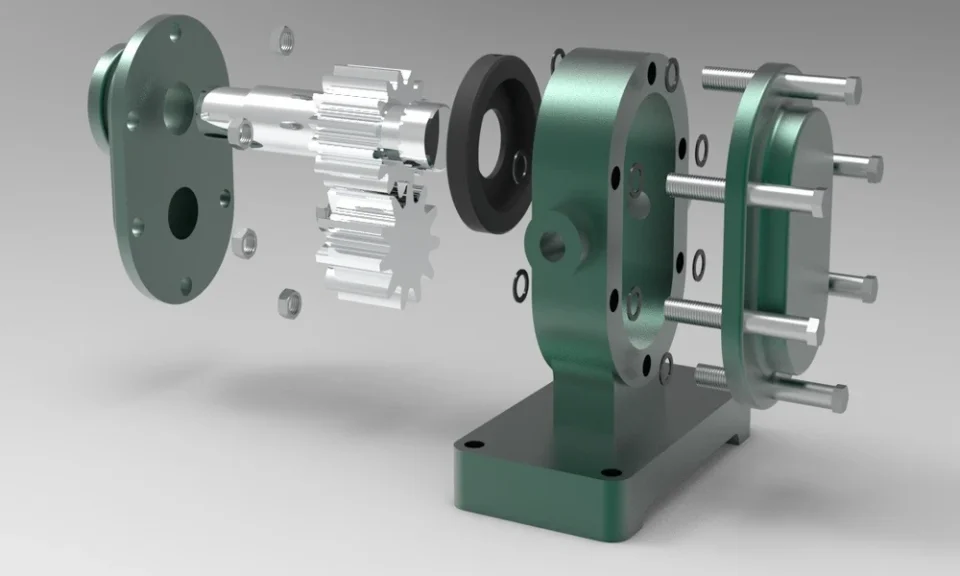
Rotary gear pumps are among the most widely used positive displacement pumps in industrial applications, valued for their ability to handle viscous fluids, deliver consistent flow rates independent of discharge pressure, and maintain self-priming capability across a range of operating conditions. The closely related rotary trochoidal gear pump, sometimes called a gerotor pump, offers specific performance advantages in applications where low pulsation, compact size, and smooth flow are priorities. Understanding the differences between these pump families and what determines their selection for specific applications helps engineers and procurement teams specify equipment that delivers reliable performance across the operating life of the installation.
How Rotary Gear Pumps Work
A rotary gear pump operates by trapping fluid between the teeth of meshing gears and the pump casing as the gears rotate, carrying it from the suction side to the discharge side of the pump. The two principal configurations are:
- External gear pumps: two meshing spur or helical gears on parallel shafts, one driven and one idling, with fluid trapped in the tooth spaces as the gears unmesh on the suction side and discharged as they remesh on the pressure side
- Internal gear pumps: a driven external gear and a larger internal ring gear on concentric shafts, with a crescent-shaped separator dividing the suction and discharge ports
Both configurations are classed as positive displacement pumps, meaning that each revolution of the drive shaft displaces a fixed volume of fluid regardless of the pressure differential across the pump, making rotary gear pump manufacturers in India products particularly suitable for metering, dosing, and viscous fluid transfer applications.
What Makes the Trochoidal Gear Pump Different
The rotary trochoidal gear pump uses an inner rotor with N lobes meshing with an outer rotor with N+1 lobes in a trochoidal geometry, the same basic principle as a gerotor. The smooth, continuous meshing action of trochoidal rotors produces inherently lower flow pulsation than external gear pumps of equivalent displacement, making the trochoidal gear pump the preferred specification for applications where pulsation must be minimised.
Hydraulic power steering systems, automatic transmission oil circuits, and sensitive fluid metering applications in pharmaceutical and food processing are among the primary applications where the low-pulsation characteristic of trochoidal pumps is a decisive specification advantage.
Viscous Fluid Handling Capability
Hydraulic gear pump manufacturers in India and elsewhere produce gear pumps for fluid viscosity ranges that span from very low-viscosity light oils through to extremely high-viscosity greases and polymers. As fluid viscosity increases, the internal leakage across the gear tooth clearances decreases proportionally, meaning that gear pumps actually perform more efficiently at higher viscosity. This counter-intuitive characteristic makes gear pumps the default specification for high-viscosity fluid transfer in applications such as heavy fuel oil transfer, bitumen pumping, and polymer processing.
Temperature and Pressure Handling
Trochoidal gear pumps are also valued for their ability to operate reliably across demanding temperature and pressure conditions. Their compact rotary design supports consistent fluid displacement while maintaining controlled internal clearances, making them suitable for applications where conventional pumping methods may struggle. Depending on the pump construction and materials selected, trochoidal gear pumps can handle elevated operating temperatures and pressures while maintaining dependable performance. This makes them a practical choice for hydraulic systems, lubrication circuits, fuel handling, and other industrial applications requiring stable flow under challenging operating conditions.
Shuttle Block Pumps: A Variant for Specific Applications
Shuttle block pump manufacturers in India produce a related positive displacement pump design in which a reciprocating shuttle element replaces the rotating gears, providing very accurate volumetric displacement for metering applications where gear pump accuracy is insufficient. Shuttle block pumps are used in custody transfer metering, chemical dosing systems, and applications where the regulatory precision of the volume delivered must be demonstrably verifiable.
Key Selection Criteria
When specifying a rotary gear pump, the primary selection parameters are:
- Fluid viscosity at the operating temperature, which determines the appropriate clearance specification and materials
- Required flow rate and the system’s pressure drop at that flow rate
- Fluid compatibility with the pump’s wetted materials including gears, casing, and seals
- Temperature range of the fluid, which affects both viscosity and material compatibility
- Pulsation sensitivity of the downstream system, which may favour a trochoidal design
Conclusion
Rotary gear pumps and rotary trochoidal gear pumps provide reliable, versatile positive displacement pumping across a wide range of industrial applications. Correct specification against the viscosity, pressure, flow, and fluid compatibility requirements of the specific installation ensures performance that matches the pump’s engineering capability and delivers the service life that well-maintained gear pumps reliably provide.
